Yunjincheng Restaurant
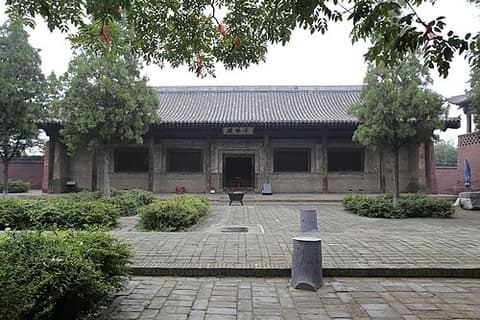
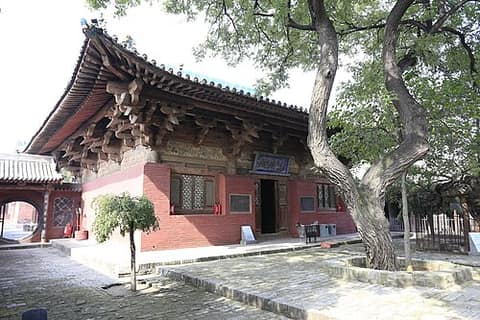
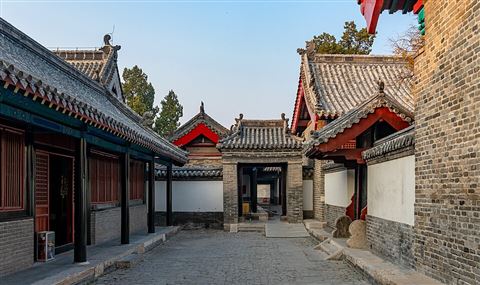
Inside Yunjincheng Folk Hotel - a ~300-year-old courtyard residence on South Avenue. Pingyao Wantuo (cold buckwheat noodles), aged Pingyao beef, oat-flour Kaolaolao. Classic Shanxi banquet setting.
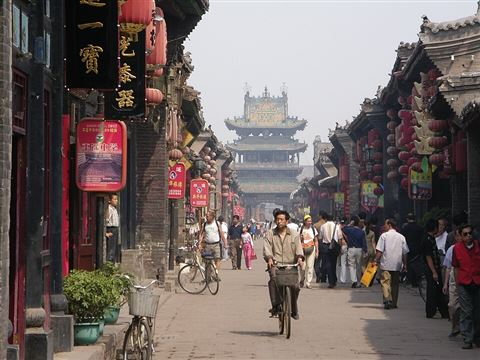
Old walled city itself = the highlight. Optional Yuncheng salt lakes day trip.
Compressed to 1 day; arrive Beijing Sat 10/24.
Cheapest reliable pick: a modern international chain just outside the walls, with standardized rooms and free breakfast, guaranteed sit-down bathrooms.
A 170-room 4-star inside the walls steps from the Confucian and City God temples, big enough to put a whole group under one roof.
Atmospheric splurge: a Qing-dynasty courtyard mansion inside the walls with modern private en-suite bathrooms; the real Ming-Qing inn feel without losing comfort.
Prices are typical double-room estimates for late October, not live quotes. Lock in early. All picks are sit-down-toilet hotels near the group's base.
Inside Yunjincheng Folk Hotel - a ~300-year-old courtyard residence on South Avenue. Pingyao Wantuo (cold buckwheat noodles), aged Pingyao beef, oat-flour Kaolaolao. Classic Shanxi banquet setting.
Beef hotpot specialist at 84 South Avenue, Pingyao Ancient City. The local favorite alongside Yunjincheng - same street, very different vibe.

The walls themselves count as 'frozen-decay' - walk them at dusk.
Massive Mao-era steelworks; you transit through Taiyuan to/from Pingyao.

CCP wartime base from September 1937. Most inhabitants lived in yaodong cave dwellings carved into Loess Plateau hillsides after Japanese bombing destroyed nearly all surface buildings except a pagoda.
The original red base. Full pilgrim-circuit including yaodong cave houses Mao lived in. Major detour from Pingyao (~5h).
Another glass cliff walk.
Yan'an. Decaying campus, urbex bait.
Stop on the Beijing↔Pingyao corridor; concrete-and-marble shrine, giant Mao.

District of Ordos, Inner Mongolia. Internationally known as a 'ghost city' around 2009 due to its small population relative to built-up scale. Population reached ~120,000 by 2021.
Ordos ghost city - the original. Has slowly filled in but still surreal.

322 km² geopark in Linze and Sunan counties, Zhangye, Gansu. Striped-rainbow Danxia landforms - sedimentary rock sculpted by wind and rain.
Rainbow Danxia mountains. Very remote but unmistakably bucket-list.

System of ~500 Buddhist temples 25 km southeast of Dunhuang, Gansu. 1,000 years of Buddhist art on the Silk Road. UNESCO.
Dunhuang Buddhist grottoes. UNESCO. Pair with Singing Sands; major detour.

Towering 'singing' sand dunes about 6 km south of Dunhuang, Gansu, that produce a deep booming sound when the sand shifts. Wraps around the small crescent-shaped freshwater oasis lake of Yueyaquan.
Dunhuang - pair with Mogao if going.

Buddhist cliff-cave temple complex in the Qilian Mountains south of Zhangye, Gansu. Grottoes, sculptures, and murals first carved in the Northern Liang/Jin period (~4th-5th c.). Name means 'Horse Hoof Temple'.
Cliff caves, Zhangye area. Pair with Geopark.

Capital of the Tocharian Jushi Kingdom 108 BC - 450 AD, on a 1,650 m islet between river branches in the Yarnaz Valley, 10 km west of Turpan, Xinjiang. Important Silk Road stop.
Carved earth city near Turpan. Spectacular but Xinjiang detour.

If you do Yumen Ghost Town anyway - adjacent decaying refinery is where the actual collapse happened.

Walled city founded 1032, traded under the Tangut Western Xia dynasty. ~25 km south of Ejin Banner, Inner Mongolia. Sacked by Genghis Khan 1226; abandoned ~1380. 9.1 m ramparts.
Tangut-era fortress in the Gobi. Stunning but extreme detour.

The Badain Jaran Desert in Inner Mongolia/Alxa contains 140+ spring-fed lakes nestled between some of the world's tallest stationary sand dunes (megadunes). Some freshwater, some hypersaline; colors shift seasonally.
Badain Jaran. Extreme detour.

Western Gansu, where China's first oilfield was established in 1939. After the city government relocated in 2003, the old urban area's population fell from ~135,000 to ~15,000.
Oil boom-bust town in Gansu. Atmospheric but very remote.

Runs from Xining to Lhasa with 960+ km of track above 4,000 m - the highest railway line in the world. Tanggula Station at 5,068 m is the world's highest railway station.
World's highest train. Need to BE traveling Tibet.

Kashgar. Xinjiang far.